
The Stages of Fasting by Hour
By Dino Pohilj, Founder, RealFoods · Drafted with AI
Stages of fasting by hour: quick summary
When you stop eating and give your digestion a rest, your body goes through five metabolic stages. Hours are counted from your last meal, and each range is approximate:
| Stage | Hours since last meal | What happens |
|---|---|---|
| 1. Getting started | 0 to 4 | Your body digests and absorbs the last meal. Blood sugar and insulin rise and fall with what you ate. |
| 2. Stabilizing | 4 to 12 | Blood sugar settles and insulin falls as the liver releases stored glycogen. Hunger waves may appear. |
| 3. Fat burning | 12 to 16 | Liver glycogen runs lower and, for many people, the body shifts toward stored fat. Ketone production starts to rise. |
| 4. Autophagy | 16 to 24 | Cellular recycling (autophagy) is thought to increase. Evidence is mostly from animal studies, so human timing is approximate. |
| 5. Deep ketosis | 24+ | Ketone levels keep rising and ketones supply more of the fuel for your brain and body. |
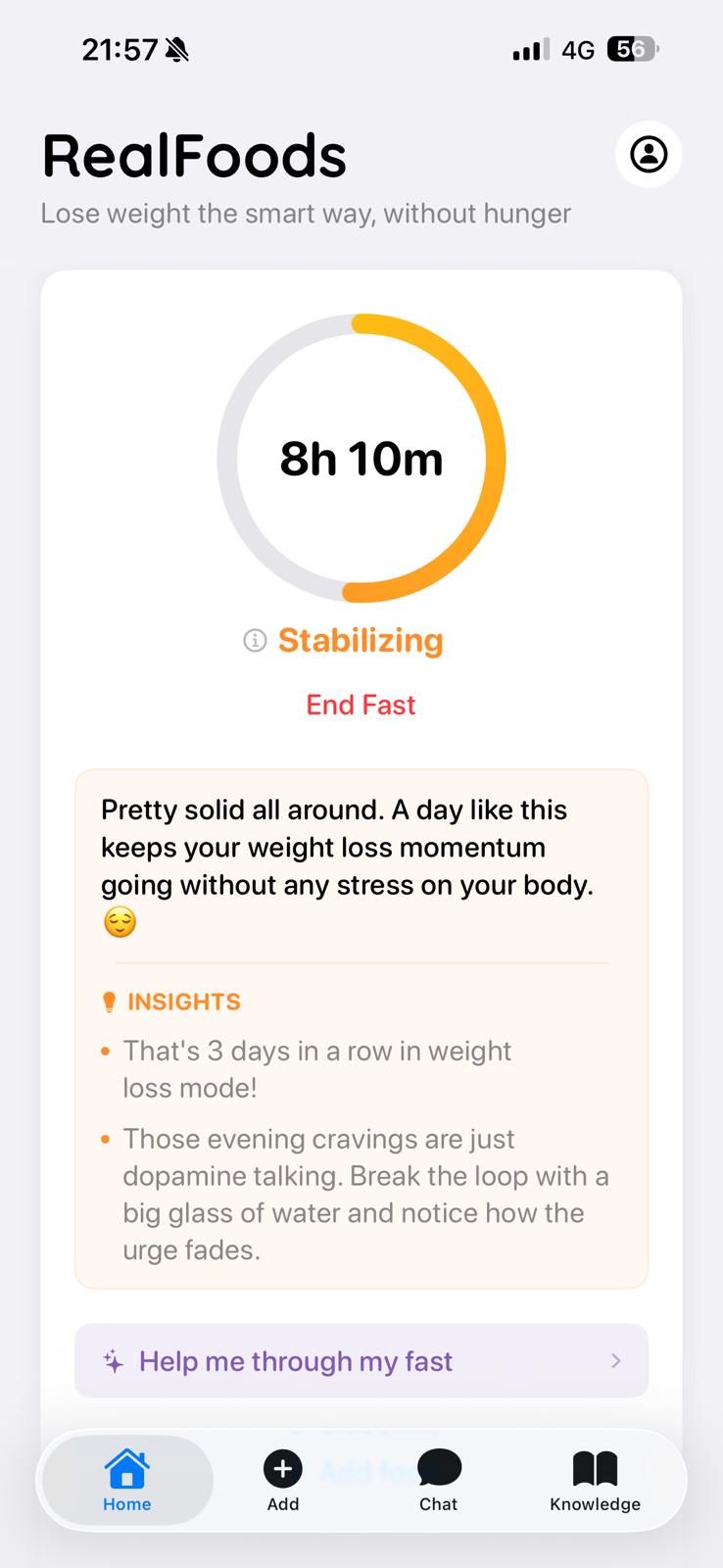
You don't need to be a biohacker to be curious about fasting, and it is an option some people choose, never a requirement. At its core, fasting is simply a longer gap between meals, which gives your body more time to move from digesting food toward drawing on stored energy. Here is what is likely happening at each stage, and how the RealFoods AI Coach tracks it for you.
Getting Started
Your body is still actively digesting and absorbing the last meal you ate. Textbook physiology says this fed (absorptive) state can last up to about 4 hours, depending on the meal (OpenStax Anatomy and Physiology). Blood sugar and insulin rise and fall with what that meal contained, which is what the Weight Impact Score estimates: a meal built on protein, fat and fibre is likely to give a smaller rise than one built on refined starch or sugar. There is nothing to do yet, just let your body process the food.
Stabilizing
Your blood sugar has settled. Your body has likely used up the immediate energy supply from your last meal and is now reaching into your liver for stored energy (glycogen). During this window, you might feel a hunger wave, often around the time you would normally eat. Waves tend to rise and then ease on their own (step 4 below explains why).
Fat Burning
This is the sweet spot. As liver glycogen runs low and insulin falls, your body likely shifts toward fat for fuel, breaking stored fat down into free fatty acids and ketones. A 2018 review in Obesity (Anton et al.) calls this the metabolic switch and says it typically occurs beyond 12 hours after your last meal, anywhere from 12 to 36 hours depending on liver glycogen at the start of the fast and on activity. Meals in the Burning Fat or Mostly Neutral zones (Weight Impact 1 to 4) are one option for people who want to support this stage. For food choices that keep insulin lower outside fasting hours, see the five food steps that lower insulin naturally. If you are fasting, check what actually breaks a fast, since not every drink ends it.
Autophagy
Without the burden of digestion, cells step up a recycling process called autophagy, which literally means "self-eating". Damaged parts are broken down and reused. In animal studies, fasting reliably switches autophagy on. In people the evidence is thinner and the timing is not firmly established. In a 2022 study, intermittent 24-hour fasts raised autophagy markers in mouse liver, but in the muscle of women fasting 24 hours three days a week the markers did not rise overall, and the authors linked the fall they saw to weight loss (Chaudhary et al., Nutrition 2022). The authors of a 2024 trial protocol note "a notable lack of human studies". Treat 16 to 24 hours as an estimate, not a switch.
Deep Ketosis
Ketone levels keep rising as your liver likely turns stored body fat into ketones, and ketones supply more of the fuel for your brain and body. Some people report a surge in energy, less physical hunger and clearer thinking at this stage. Longer fasts are not right for everyone. If you are pregnant, take medication that affects blood sugar or have a history of disordered eating, talk to your doctor before trying one.
What happens hour by hour during a fast?
Hour by hour, a fast hands your fuel supply from the last meal's sugar, to the liver's stored glycogen, to sugar the liver makes new, and finally to fat and ketones, with each handover happening gradually rather than at a fixed minute. The clearest human data on that handover comes from a 68-hour fasting study that tracked liver glycogen directly (Rothman et al., Science 1991).
| Hours since last meal | Main fuel | What the research says |
|---|---|---|
| 0 to 4 | Sugar from the meal you just ate | The fed state can last up to about 4 hours, depending on the meal. |
| 4 to 12 | Stored liver glycogen, plus sugar the liver makes new | Once the meal is absorbed, the body relies first on stored glycogen. |
| 12 to 22 | Glycogen running lower, with more fat and ketones | The metabolic switch to fat and ketones typically begins beyond 12 hours. Over the first 22 hours, about 64% of the body's blood sugar was newly made rather than drawn from glycogen. |
| 22 to 36 | Mostly fat, with ketones rising | Newly made blood sugar rose to about 82% of the supply over the next 14 hours. The switch can take up to about 36 hours, depending on glycogen and activity. |
| 36 to 72 | Fat and ketones, with blood sugar almost all newly made | Later in the fast, newly made blood sugar reached about 96% of the supply. After several days without food, ketones become a major fuel for the heart and other organs. |
A daily 12 to 16 hour fast stays within the first three rows. Fasts that run past 24 hours, into days 2 and 3, are not right for everyone: if you are pregnant, take medication that affects blood sugar or have a history of disordered eating, talk to your doctor first.
How some people do a 16-hour fast, step by step
Some people choose a 16-hour overnight fast to reach stage 3, because most of it happens while they sleep. Fasting is optional, and you never need it to benefit from RealFoods. If you do want to try one, five steps cover it, from the last bite to the first meal. If you are pregnant, take medication that affects blood sugar or have a history of disordered eating, talk to your doctor before you try it.
Step 1: Note the time of your last bite
Hour 0 starts when you finish eating, not when you go to bed. A dinner built around protein, vegetables and fat, with a lower estimated WI Score, gives blood sugar and insulin less to come down from in stage 1.
Step 2: Let sleep cover stages 1 and 2
Finish dinner around 8pm and you reach hour 12 at 8am. Digestion and blood sugar settling happen mostly overnight, so the hardest part of the fast is the morning, not the night.
Step 3: Keep drinks plain
Water, black coffee and plain tea keep the fast going. Milk, juice, sugary drinks and any food end it. Sweeteners sit in a gray zone; see what actually breaks a fast for the full ruling.
Step 4: Ride out hunger waves
Hunger tends to come in waves rather than build in a straight line. In a 24-hour fasting study of six healthy adults, the hunger hormone ghrelin rose around their usual meal times and then fell again on its own, without food (Natalucci et al., European Journal of Endocrinology 2005). A glass of water, a coffee or a short walk can help a wave pass, and if you are hungry, eating is always an option.
Step 5: Break the fast with whole foods
Start with eggs, Greek yogurt, fish or chicken with vegetables, then add the toast, rice or fruit you enjoy if you still want them. Meals built on protein, fat and fibre are likely to give a gentler blood sugar rise than bread, pastries or pasta on their own. A modest first plate is easier on a stomach that has been resting.
Ready to stop guessing what to eat?
Scientific Evidence: The metabolic stages described on this page, glycogen depletion, the transition to lipid utilisation, and cellular autophagy, are described in the peer-reviewed literature. For a comprehensive review, see the NEJM Intermittent Fasting Review (de Cabo & Mattson, 2019) in our research repository. The 12 to 36 hour metabolic-switch range comes from Anton et al., Obesity 2018 (PMID 29086496), the fed-state window from OpenStax Anatomy and Physiology, and the human autophagy caveat from Chaudhary et al., Nutrition 2022 (PMID 35660501) and Masedunskas et al., Nutrients 2024 (PMID 39770918). The hour-by-hour figures for newly made blood sugar come from Rothman et al., Science 1991 (PMID 1948033), the hunger-wave pattern from Natalucci et al., European Journal of Endocrinology 2005 (PMID 15941923), and the prediabetes trial from Sutton et al., Cell Metabolism 2018 (PMID 29754952).
Common questions
What are the stages of fasting by hour?
The stages of fasting are five overlapping phases after your last meal: digesting (about 0 to 4 hours), blood sugar settling (4 to 12 hours), a shift toward burning fat (around 12 to 16 hours), possible autophagy (16 to 24 hours) and deeper ketosis (24 hours and beyond). These are approximations that vary with your last meal, your liver glycogen stores and your activity, and the autophagy window is an estimate because most of the evidence comes from animal studies.
How long do you have to fast to start burning fat?
Around 12 hours for many people. A 2018 review in Obesity says the metabolic switch, when liver glycogen runs low and the body mobilises fat and ketones, typically occurs beyond 12 hours after your last meal and between 12 and 36 hours depending on liver glycogen and activity. The 12 to 16 hour window is a commonly studied range for daily intermittent fasting.
When does autophagy start?
The exact timing in people is not established. Fasting switches autophagy on in animal studies, but human evidence is limited: a 2022 trial found autophagy markers rose in mouse liver but not overall in the muscle of women doing 24-hour fasts, and a 2024 trial protocol notes a notable lack of human studies. Figures such as 16 to 24 hours are estimates, and timing likely varies from person to person.
What happens after 24, 48 and 72 hours of fasting?
After about a day, most of the blood sugar your body uses is made new by the liver rather than drawn from stored glycogen, and fat and ketones supply more of your fuel. In a 68-hour fasting study, about 64% of the body's blood sugar was newly made by the liver over the first 22 hours, about 82% over the next 14 hours and about 96% later in the fast (Rothman et al., Science 1991). After several days without food, ketones become a major fuel for the heart and other organs. Fasts this long are not right for everyone, so talk to your doctor first.
What breaks a fast?
Food, milk, juice, sugary drinks and anything else that supplies meaningful energy end a fast. Plain water, black coffee and plain tea keep it. Artificial sweeteners and sugar-free gum sit in a gray zone that leans toward keeping the fast, and the full evidence is on our page about what actually breaks a fast.
What are fasting zones?
Fasting zones is the name some fasting apps give to the same stages described on this page, counted in hours since your last meal. The labels differ from app to app, but they describe the same handover from meal sugar to stored glycogen to fat and ketones, and the hour marks are approximate for everyone.
What does research say about intermittent fasting, prediabetes and PCOS?
It may help some people, but talk to your doctor first, especially if you take medication that affects blood sugar. In a small 2018 trial, eight men with prediabetes who ate within a 6-hour window ending before 3pm for five weeks had lower insulin levels, better insulin sensitivity and lower blood pressure than on a 12-hour schedule, even though their weight did not change; their blood sugar levels did not improve (Sutton et al., Cell Metabolism). For food choices alongside any fasting window, see the prediabetes food guide. For PCOS, the research on fasting is early and mixed, as our PCOS and insulin resistance guide explains.
